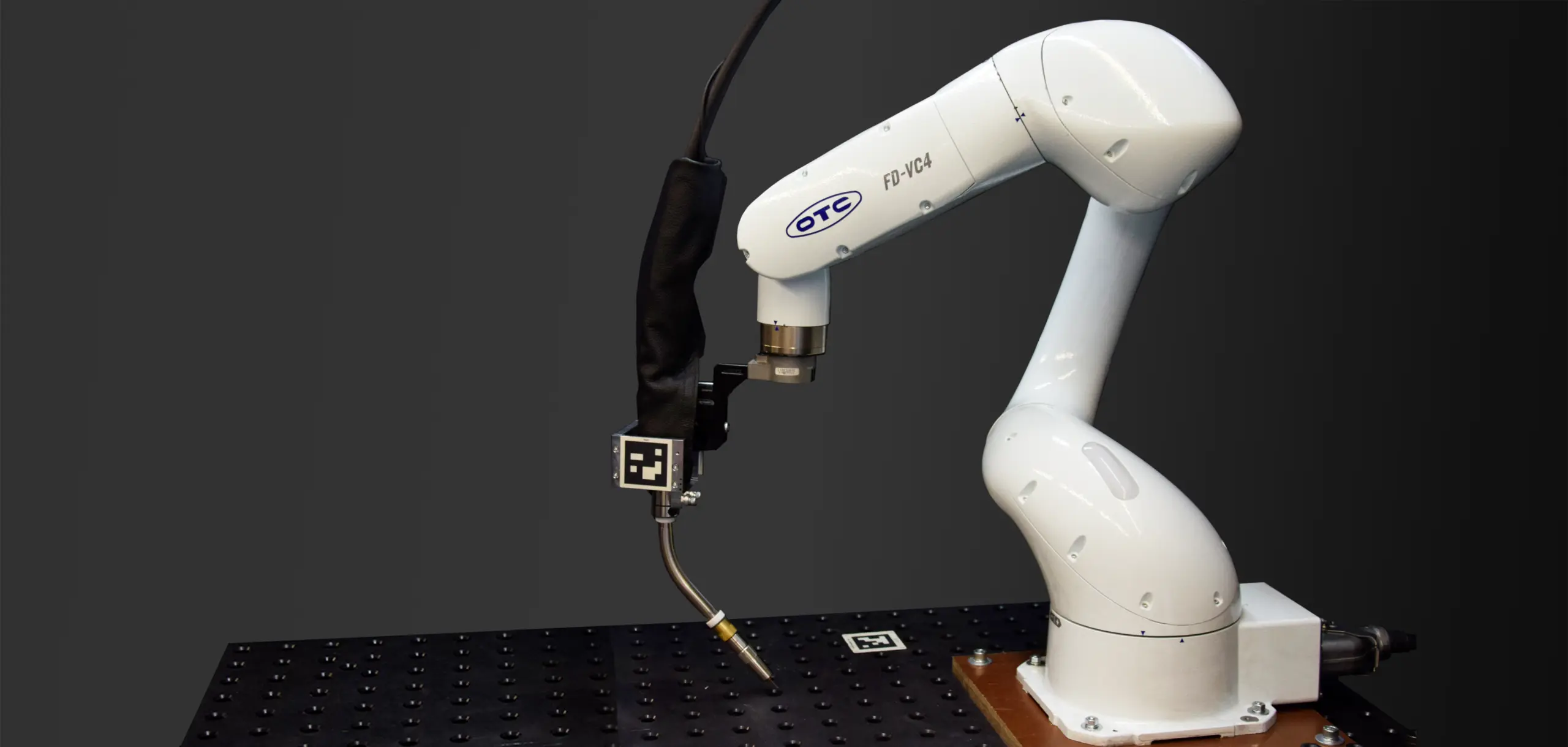
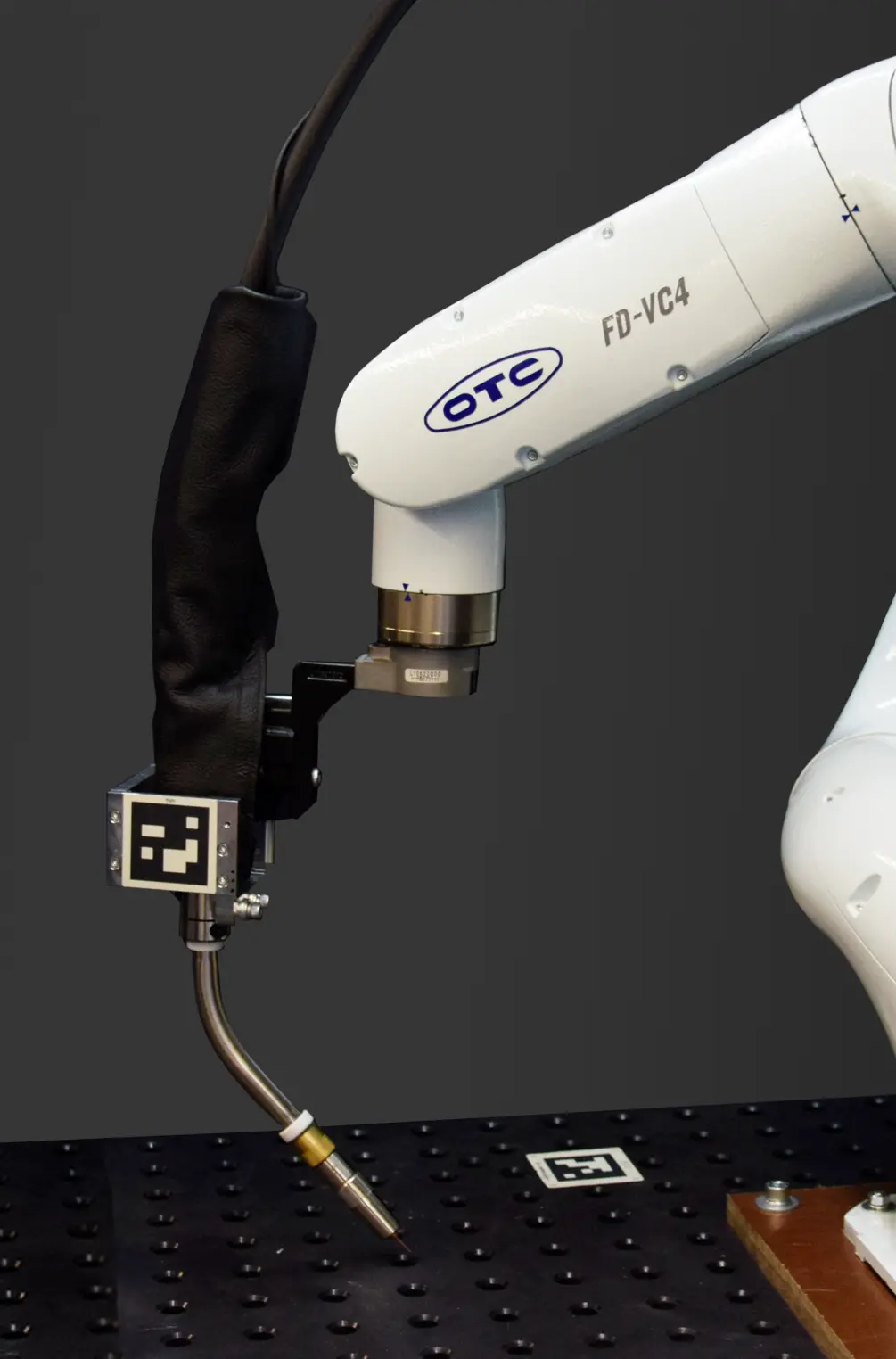
Ideal welding cobot for the shop floor
THE FIRST REAL WELDING COBOT
The OTC Cobot FD19-VC4 is compatible with the complete OTC welding technology and sensor portfolio and is the first Cobot specifically developed for welding applications.
This Cobot provides an easy entry into automation without extensive cobot training, thanks to the simple teach-in method developed by OTC DAIHEN EUROPE GmbH, experts in the field for years. In 1983, OTC pioneered the use of a teach pendant to program robots and welding equipment on a single device. In 2023, OTC continues this work with the first visual programming of robots and welding technology on a single device with PhotoTeach.
The OTC solution for the automation trend is the Cobot VC4, which does not require any equipment from the operator and is also a ready-to-weld Cobot with the following features:
- Spatter proof design
- User friendly programming / teaching
- For welding modified axis (high accuracy)
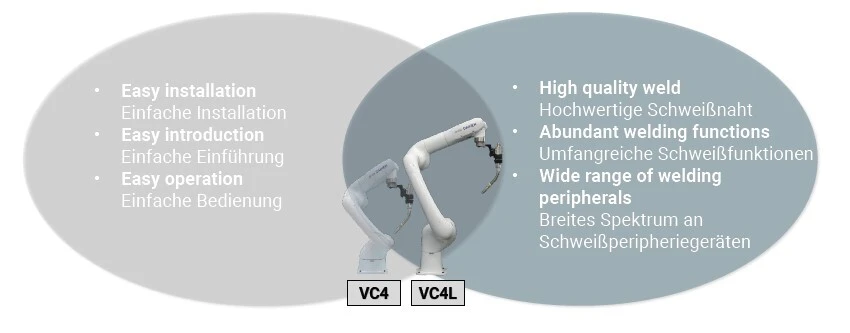
The first collaborative robot (Cobot) VC4 from OTC stands out for its ease of use and marked the introduction of our series of collaborative robots. With the long-arm Cobot VC4L, we offer excellent welding performance equivalent to that of industrial robots. Both models are functionally compatible and can be easily integrated into existing processes.

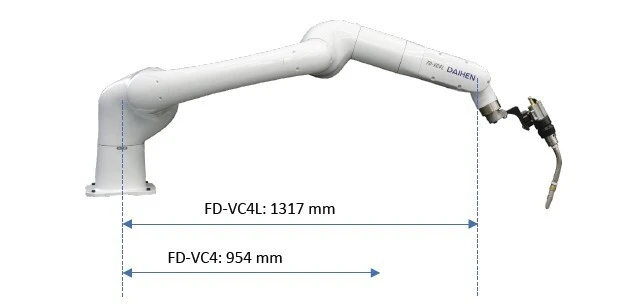
Compared to the VC4, the long-arm Cobot achieves a reach that is 1.4 times greater. The expanded motion range allows for diverse applications, such as multi-station setups. Despite its maximum reach, the robot remains in the same transportable class of collaborative robots.
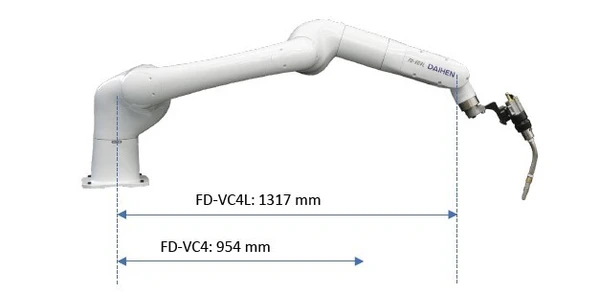
Optimal welding robot for the shop floor
With its modern design and easy application, the Cobot is the optimal welding robot for the shop floor.
Function Features
1. High trajectory accuracy optimal for arc welding
Optimal for welding applications equivalent to industrial robots
2. High frequency resistance
Perfect for applications where high frequency noises are generated such as TIG welding.
3.High durability, dust- and spraywater protection
Conform to IP65 standard.
Cobot protection against heat radiation and spatter -> no covering required
4. Complete OTC welding portfolio applicable
Ready to use OTC industrial robot accessories such as standard welding equipment, SynchroFeed, ServoTorch, sensors etc.

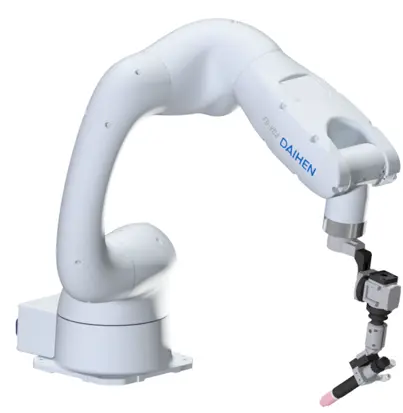
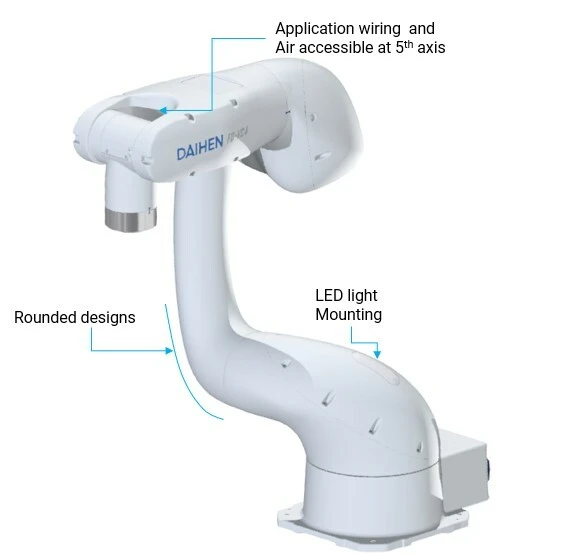
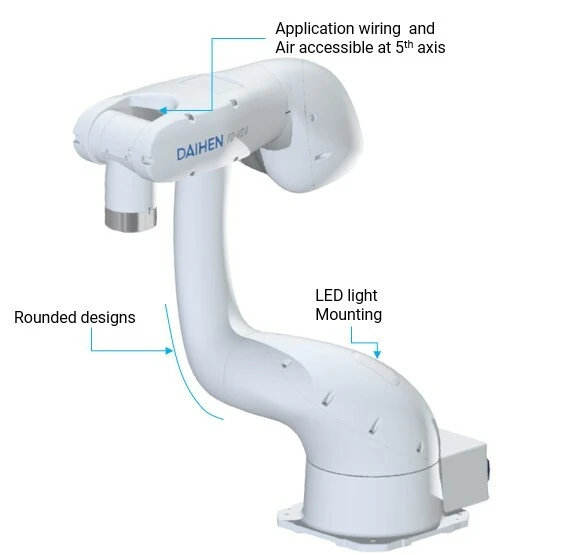
Design Features
1. Collaborative Design without corners and edges
Floating Design without corners and no risk of crushing.
Minimized risk for injuries due to collision detection.
2. Lightweight, small-sized, easy to move
Compared to smallest OTC industrial robot H5 with 58 kg, our VC4 cobot has a weight of 37 kg -> 36% weight reduction
3. LED status indication
VC4 cobot working mode is displayed on the top of the second robot axis.
4. Complete cobot cabling inside the main unit
Wiring and air connection are accesible at the 5th axis
Frequently Asked Questions About Our Cobots
FAQ
Would you like to learn more about OTC Cobots and their use in automated welding? Here you will find answers to frequently asked questions about the operation, advantages, applications and integration of collaborative welding robots.
What is a Cobot?
A Cobot, short for collaborative robot, is a robot designed to work alongside people in industrial applications. Cobots enable flexible automation solutions and are particularly suitable for processes where people and robots are intended to operate within a shared working environment.
What is the difference between a Cobot and a conventional industrial robot?
Conventional industrial robots are often designed for high speed, reach and payload capacity and are typically used within safeguarded robot cells. Cobots, on the other hand, are designed for collaborative applications and enable closer interaction between people and robots. Which solution is more suitable depends on the application, required performance and safety concept.
What are the advantages of Cobots in production?
Cobots enable flexible automation of various production processes and can be particularly useful for repetitive or ergonomically demanding tasks. They can help reduce the physical workload on employees, standardize processes and increase productivity. Their flexible deployment also makes them suitable for changing production requirements.
What applications are Cobots suitable for?
Cobots can be used for a wide range of automation tasks. Typical applications include handling, machine tending, assembly, positioning and other repetitive manufacturing processes. The specific application depends on the payload capacity, reach, tooling, process and safety requirements.
Can Cobots also be used for welding?
Cobots can also be used for automated welding applications, provided that the robot, welding technology and safety concept are suitable for the specific application. A flexible robotic solution can be particularly beneficial for smaller production runs or frequently changing workpieces. In addition to robot movement, the hazards associated with the welding process must also be taken into account and appropriate safety measures implemented.
Does a Cobot eliminate the need for safety fencing?
Using a Cobot does not automatically mean that protective measures are unnecessary. The required safety concept depends on the entire application, including the tooling, workpiece, speed and process. An individual risk assessment is therefore required for every robotic application to determine the necessary protective measures.
Are Cobots safe for working alongside people?
Collaborative robotic systems are designed for applications where interaction between people and robots may be possible. However, the safety of the entire application is always the key consideration. In addition to the robot itself, tools, workpieces, motion sequences and potential process hazards must also be taken into account as part of the risk assessment.
What payload capacities do OTC DAIHEN Cobots offer?
The payload capacity depends on the specific Cobot model. OTC DAIHEN offers collaborative robot models for compact and flexible automation tasks. When selecting a model, the weight of the workpiece as well as the gripper, tooling, cables and other components should be taken into account.
How do I choose the right Cobot for my application?
Important selection criteria include payload capacity, reach, working range, required tooling, cycle time and the specific task to be performed by the robot. The available space and requirements for collaboration between people and robots should also be considered. Based on these factors, the appropriate Cobot configuration can be determined for the specific production process.
Are Cobots suitable for small and medium-sized production runs?
Cobots can be particularly attractive for production environments where different components or smaller batch sizes need to be automated. Flexible robotic concepts allow production processes to be adapted to changing requirements while automating repetitive tasks.
Can a Cobot be integrated into an existing production system?
In general, Cobots can also be integrated into existing production and automation systems. The specific implementation depends on the available interfaces, space, machinery, tooling and safety requirements. Before integration, the existing system and the intended process should therefore be assessed individually.
When is it worthwhile to use a Cobot?
A Cobot can be a suitable choice when repetitive processes need to be automated flexibly, employees need support with ergonomically demanding tasks, or different production variants need to be handled with a single robotic solution. Whether a Cobot or a conventional industrial robot is the more economical solution should be evaluated based on the specific application, cycle time and production requirements.