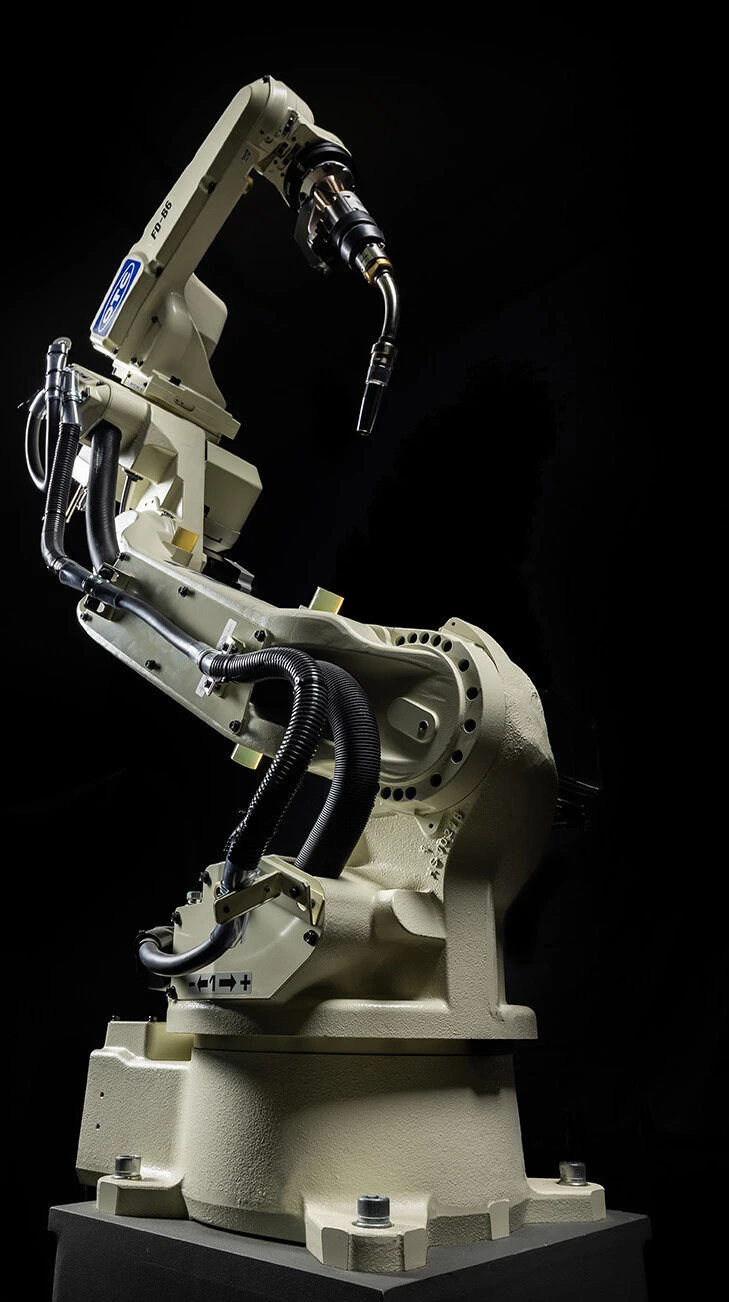
Standardized, long service life, low maintenance costs
6-AXIS INDUSTRIAL ROBOTS
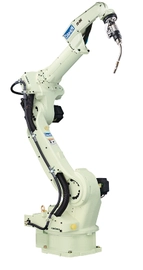
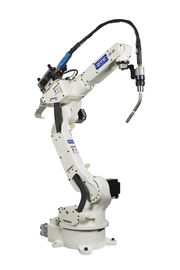
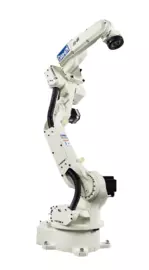
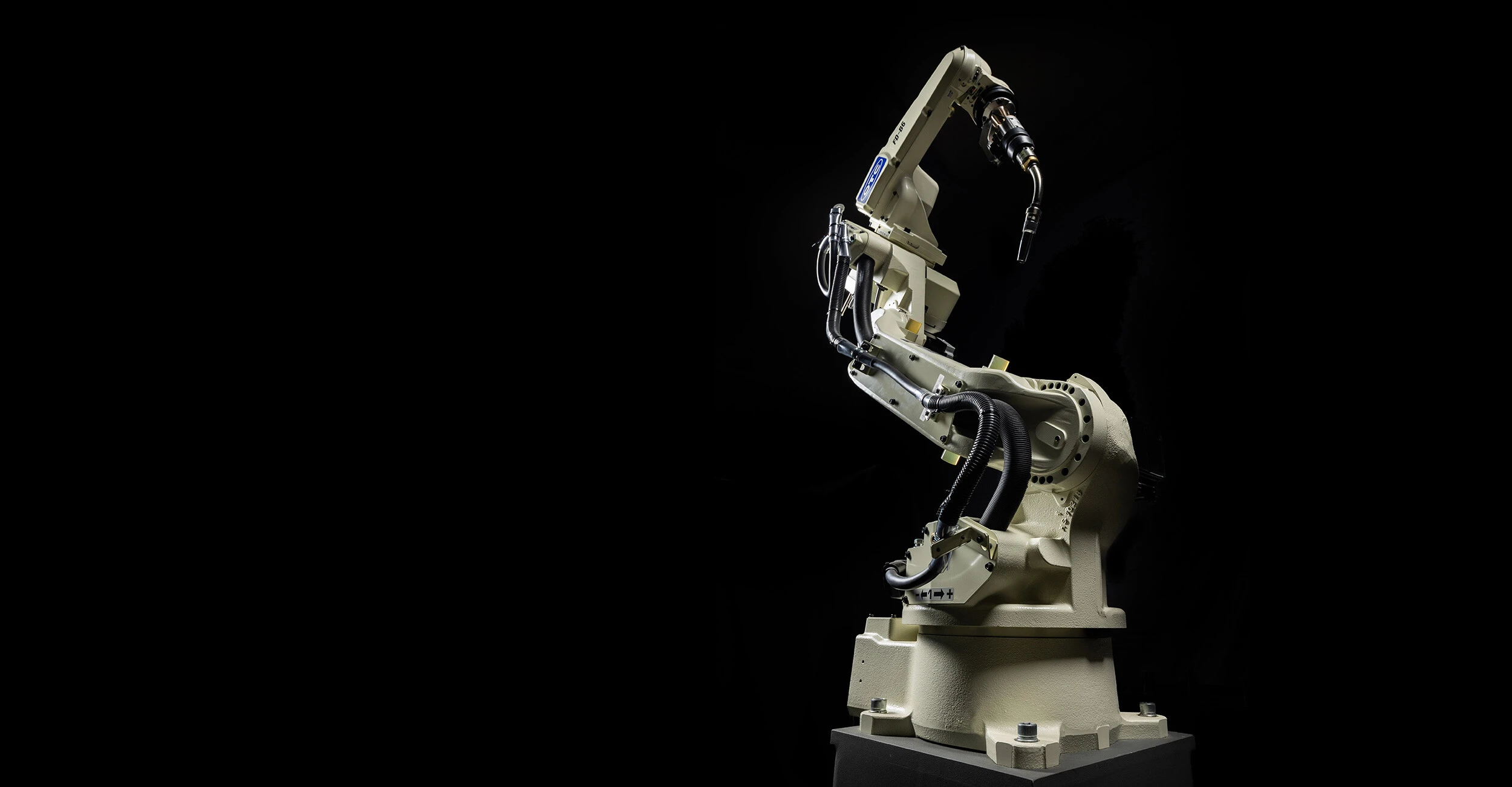
The 6-axis robots from OTC DAIHEN offer a high degree of freedom of movement for a wide range of automated welding applications. With six axes, they can reach workpieces from different positions and angles and precisely execute complex motion sequences. Our portfolio ranges from compact robots for light payloads and models designed for particularly high precision requirements to robots with hollow-arm designs or extended working ranges. The range is complemented by powerful models in the medium payload class. This makes it possible to select the right 6-axis robot for the specific application and system configuration.
Quick facts:
- Six axes for a high degree of freedom of movement
- Wide portfolio for a variety of welding applications
- Models for light and medium payloads
- Special versions for high-precision requirements
- Hollow-arm robots for welding applications
- Models with an extended working range
- Different robot sizes for flexible system concepts
6-Axis Robots for Different Requirements
VERSATILE SOLUTIONS FOR AUTOMATED WELDING
Not every welding task places the same demands on a robot. That is why OTC DAIHEN offers a range of 6-axis robot models specifically designed for different applications. From compact solutions and high-precision robot models to hollow-arm variants and robots with particularly long reach, a versatile portfolio is available for industrial welding automation.
H5 - Light Payload Robot
The H5 expands the portfolio with a compact solution for light-payload applications. It is suitable for automation tasks that require a compact robot solution and flexible motion sequences.
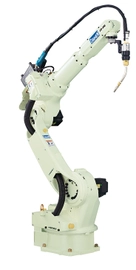
A20 - High-Accuracy Robot
The A20 is designed for applications with particularly high accuracy requirements. It provides a specialized robot model within the 6-axis series for precise automated processes.
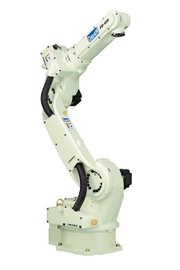
B26 - Hollow Arm Robot
The B26 combines the freedom of movement of a 6-axis robot with a hollow-arm design. This design is specifically tailored to the requirements of automated welding processes.
V25L - Extended Long Arm Robot
For applications requiring a larger working range, the V25L features an extended arm. This makes it suitable for applications that require greater reach within the robot cell.
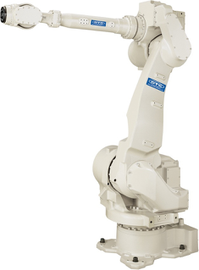
Medium Payload Robots
Our Medium Payload Robots complement the 6-axis portfolio for applications with higher payload and working range requirements.
Various robot models and sizes are available, allowing the robot solution to be selected according to the specific welding task and system configuration.
Our Medium Payload Robots
B6 | V8 | B6L | V8L | V25 | V50
With its range of models, OTC DAIHEN offers a versatile portfolio for automated welding applications – from compact robots to solutions for larger working ranges and higher payload capacities.
Frequently Asked Questions About Our 6-Axis Robots
FAQ
Would you like to learn more about our 6-axis robots and their use in automated welding? Here you will find answers to frequently asked questions about the operation, advantages, selection and integration of 6-axis robots in robotic welding systems.
What is an OTC DAIHEN 6-axis robot?
An OTC DAIHEN 6-axis robot is a highly flexible industrial robot with six controlled axes. Its six degrees of freedom enable the robot to perform complex movements and achieve different tool orientations. This makes 6-axis robots particularly suitable for automated welding processes, handling tasks and other industrial automation applications that require a high degree of freedom of movement.
What are the advantages of an OTC DAIHEN 6-axis robot?
The six axes provide a high degree of freedom of movement and allow flexible positioning of the tool on the workpiece. This enables OTC DAIHEN 6-axis robots to reach complex component geometries and difficult-to-access processing positions. Additional advantages include the automation of repetitive workflows, reproducible robot movements and the ability to integrate the robot into complete automated production and welding systems.
What applications are OTC DAIHEN 6-axis robots suitable for?
OTC DAIHEN 6-axis robots are particularly suitable for automated arc welding as well as industrial handling and positioning tasks. Their high degree of mobility is especially beneficial in applications where different areas of a workpiece need to be reached from various angles. Depending on the robot model, tooling and peripheral equipment, customized automation solutions can be implemented for a wide range of manufacturing processes.
Why are 6-axis robots frequently used for automated welding?
In robotic welding, the welding torch must follow a defined path while maintaining the correct angle relative to the workpiece. A 6-axis welding robot provides the necessary freedom of movement for this task. OTC DAIHEN combines robotics and welding technology, allowing robots, welding power sources, torches and other components to be combined into a coordinated welding automation system.
Which welding processes can be automated with OTC DAIHEN 6-axis robots?
Depending on the system configuration, OTC DAIHEN 6-axis robots can be used for various automated arc welding processes. These include MIG/MAG and TIG welding applications in particular. The appropriate welding process and technology depend on factors such as the material, component geometry, quality requirements and production task.
How do I find the right OTC DAIHEN 6-axis robot for my application?
When selecting a 6-axis industrial robot, key factors include the required reach, payload capacity, working range, component size, tooling and desired cycle time. For welding applications, the welding process, component geometry and required welding performance should also be considered. Application-specific system design helps ensure that the OTC DAIHEN robot, welding technology and peripheral equipment are optimally matched to the production process.
Can OTC DAIHEN 6-axis robots be integrated into existing production systems?
Yes. OTC DAIHEN 6-axis robots can be used both in new automation systems and for integration into existing production environments. Factors such as existing machinery, interfaces, available space, safety concepts and production processes must be taken into account. Depending on the application, the robot can also be combined with components such as positioners, sensors, welding equipment and other system peripherals.
What is the difference between a 6-axis robot and other industrial robots?
The main difference lies in the number and arrangement of the axes of motion. A 6-axis robot can change the position and orientation of its tool with a high degree of flexibility, enabling complex three-dimensional motion sequences. This flexibility makes OTC DAIHEN 6-axis robots particularly suitable for demanding welding and automation tasks where workpieces need to be processed from different positions and angles.
What is the difference between a 6-axis and a 7-axis robot?
A 6-axis robot has six axes of motion and already provides a high degree of freedom of movement for numerous industrial applications. A 7-axis robot has an additional axis that can provide greater flexibility, particularly in confined spaces or for complex motion sequences. Which configuration is more suitable depends on the specific application and system geometry.
Discover more