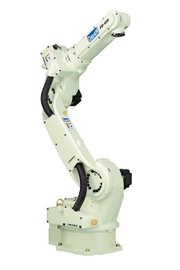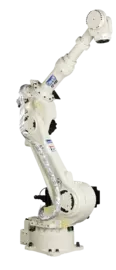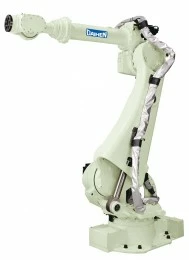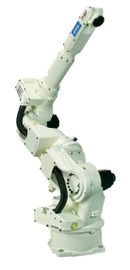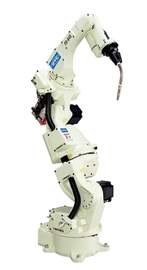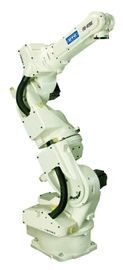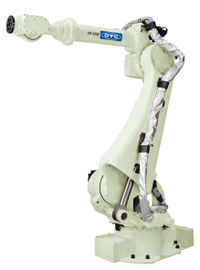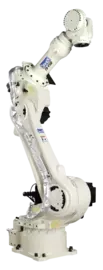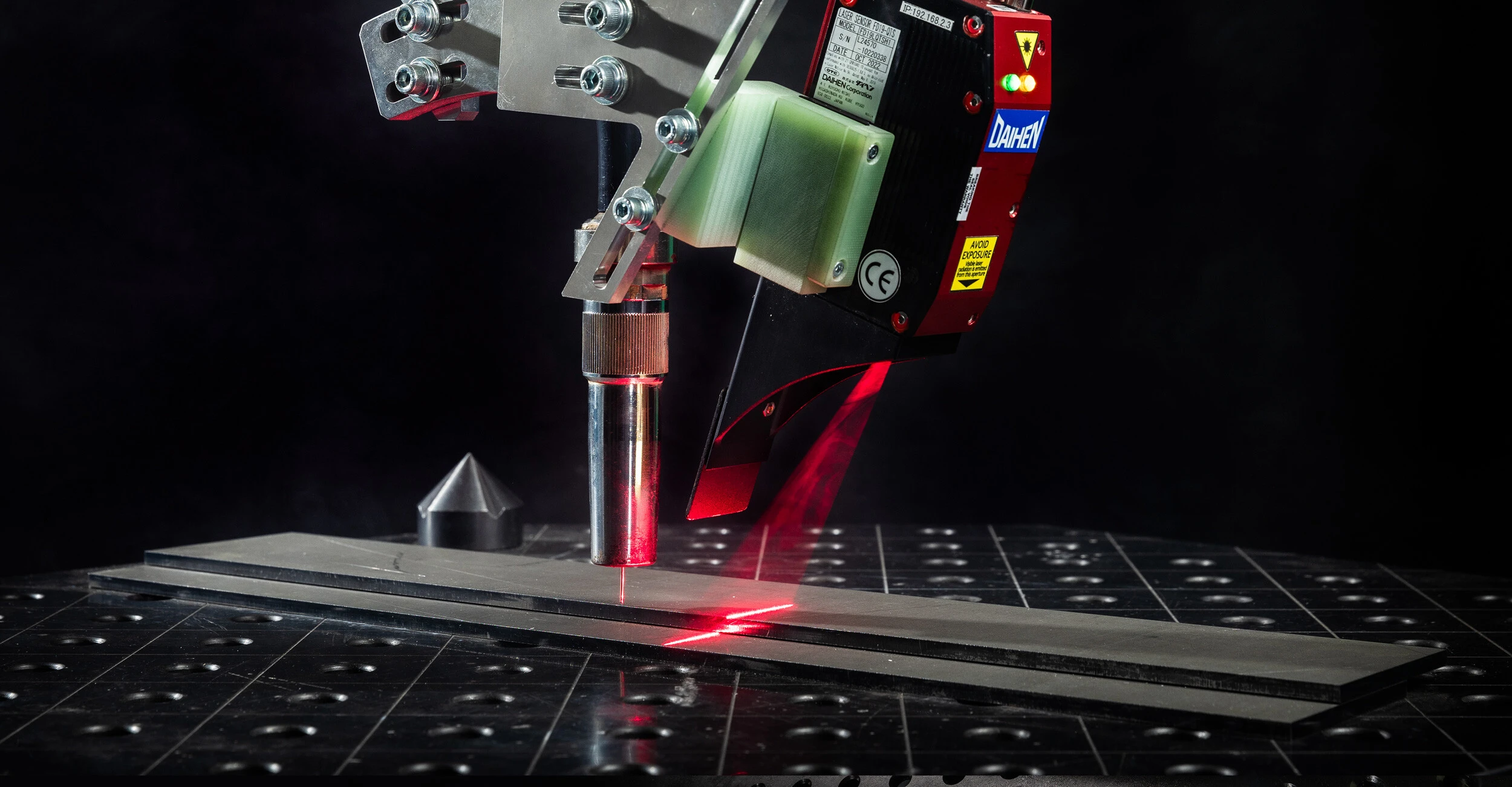
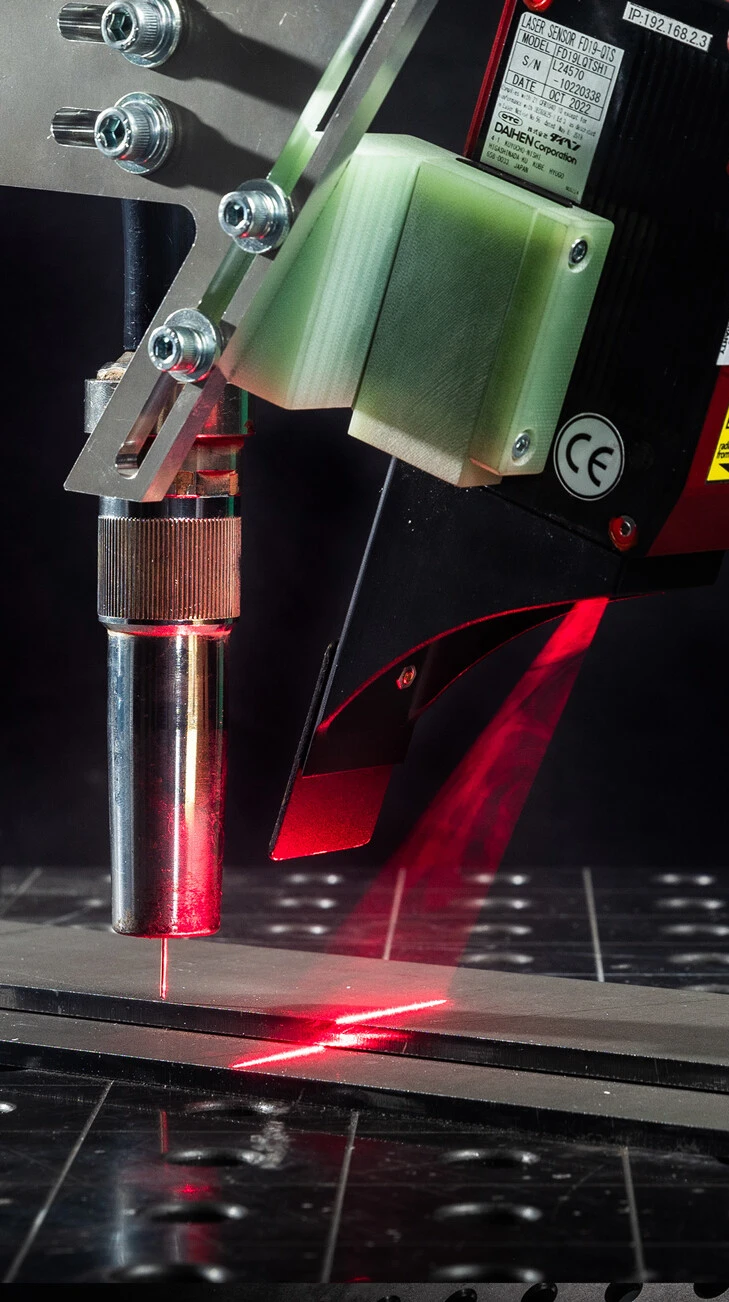
Improve efficiency with real-time sensors – tactile and optical
OUR OTC DAIHEN SENSORS
In practice, workpiece positions, orientations and weld seams can deviate from their programmed target values. To adapt automated processes to such variations, OTC DAIHEN offers various sensor solutions for welding automation.
Our sensors capture relevant information about the workpiece and welding process, enabling the system to adapt to changing conditions such as weld seam misalignment or positional tolerances. Thanks to the rapid processing of the acquired data, necessary adjustments can be made dynamically and in real time.
Different sensor concepts are available depending on the application: The FD-WD Touch Sensing Sensor is used to detect the workpiece position, while the FD-AR Arc Tracking Sensor and the FD-TR TIG Arc Sensor are used for automatic seam tracking.
The sensor solutions can be easily integrated into the process and help perform automated welding tasks with greater precision and efficiency.


Improvements to your system:
Improved accuracy and efficiency
- Incorporate real-time data about the workpiece, its position and orientation
- for more precise movements and to complete the tasks more accurately
- Detect tolerances and adjust your programming autonomously to increase performance
- Optimized movements can lead to faster and more efficient task completion
Enhanced safety
- Detect and avoid obstacles
- Avoid collisions with objects or people in its path
Frequently Asked Questions About OTC Sensors
FAQ
Would you like to learn more about our sensor solutions and their use in automated welding? Here you will find answers to frequently asked questions about real-time sensing, workpiece detection, seam tracking, selection and integration of our sensors into automated welding systems.
Why are sensors used in automated welding?
In automated processes, positional tolerances or weld seam misalignment may occur. Sensors capture information about the actual conditions and enable the process to be adjusted accordingly.
This allows programmed robot movements to be better adapted to the actual position and orientation of the workpiece.
What are the advantages of real-time sensors?
Real-time sensors provide up-to-date information about the process and workpiece. Rapid data processing enables dynamic adjustments, supporting more precise movements and more efficient execution of automated tasks.
Which sensors does OTC DAIHEN offer for automated welding processes?
OTC DAIHEN offers different sensor solutions for various tasks. The FD-WD Touch Sensing Sensor is used to detect the workpiece position. The FD-AR Arc Tracking Sensor enables automatic seam tracking through weaving motion, while the FD-TR TIG Arc Sensor is designed for vertical seam tracking in TIG welding.
What is the difference between Touch Sensing and Arc Tracking?
With Touch Sensing, the actual position of the workpiece is determined by bringing the welding wire or gas nozzle into contact with the workpiece.
Arc Tracking, on the other hand, tracks the weld seam during the welding process. The two methods therefore perform different functions within the automated welding process.
How does the FD-WD Touch Sensing Sensor work?
The FD-WD determines the workpiece position through contact between the welding wire or gas nozzle and the workpiece. This allows deviations from the intended workpiece position to be detected.
How does the FD-AR Arc Tracking Sensor work?
The FD-AR enables automatic seam tracking through a weaving motion. This allows the actual path of the weld seam to be tracked during welding.
Which sensor is suitable for TIG welding?
The FD-TR TIG Arc Sensor is available for TIG applications. It enables vertical seam tracking and is suitable for all materials as well as sheet thicknesses of 1.0 mm and above.
Which OTC sensor offers the highest accuracy?
Of the three sensor solutions shown, the FD-TR TIG Arc Sensor offers the highest specified accuracy at ±0.5 mm. The FD-WD and FD-AR each have a specified accuracy of ±1.0 mm.
Can OTC sensors be integrated into existing automation processes?
OTC sensor solutions are designed for easy integration into automated processes. This allows real-time data and sensor functions to be incorporated into the process, enabling the system to respond to deviations and changing conditions.
How do I choose the right sensor?
The selection depends on the specific welding task. The first consideration is whether the workpiece position needs to be detected or the weld seam needs to be tracked during the process.
In addition, the welding process, material, sheet thickness and required accuracy should be taken into account.